|
|
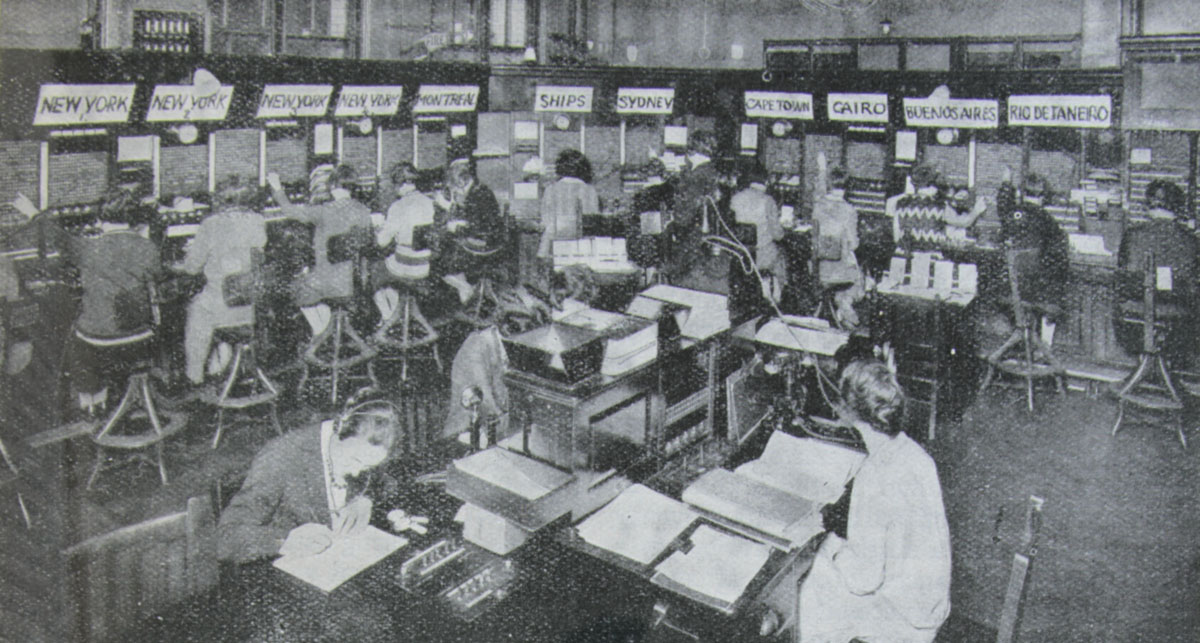
There is no “distance” nowadays when people wish to speak with each other. So efficient is our telephone system that, if we wish to speak to Buenos Aires or even to Sydney, on the other side of the world, we need only take up our telephone receiver and ask for the city in which our friend lives. Then, in a little time the bell rings and we are informed that he is listening. His voice comes to us from the end of the earth—and space is shattered. Then the wireless waves take messages with lightning speed—and give us music and speech for our entertainment. Last wonder of all—and fortunate you are to have the inventor, Mr. Baird, himself to describe it to you—comes television, greatest wonder of all.
IN these days there can scarcely be a single inhabitant of any civilised country who has not spoken on the telephone and heard the wireless; yet telephony was invented less than sixty years ago, and radio as a means of entertainment is so new that schoolboys of fourteen or fifteen must well remember its introduction. Rapid communication is a vital necessity to-day; without it no trains could run, no newspapers could be published and no commercial firm could carry on its business.
The oldest known method of conveying messages rapidly over considerable distances was by means of beacon fires. There are several old churches and castles in Britain to-day which still preserve the ancient iron basket in which the beacon fire was lit—Edinburgh Castle has one, for instance—but in the days of Queen Elizabeth beacons were so numerous that news of the approach of the Spanish Armada was signalled, by means of a continuous line of fires, from Cornwall to the Cheviots; as recently as the nineteenth century beacons were erected all over the British Isles to give warning of a threatened French invasion. But beacons have the great disadvantage that they can only report that a pre-arranged time has come or an anticipated event has happened, for a fire indicates nothing unless a message of explanation is previously sent. Nevertheless, beacons served a very useful purpose until they were ousted by quicker and more flexible methods.
Signalling by flags was employed in the British Navy in the thirteenth century, but it was not until about 1665, in the war against the Dutch, that the Duke of York’s system of flag-signalling drawn up by Sir William Penn placed the method upon a definite basis. In the eighteenth century M’Arthur, secretary to Lord Howard in the West Indies, invented a much improved system of flags, and a code of lights to convey naval messages by day and night. But all these systems suffered from the same defect, that they could only select from certain pre-arranged messages.
On land the heliograph was used until the present century to convey daylight messages by means of flashes. The heliograph is simply a mirror hinged so as to reflect the sun’s rays in a certain direction; by moving the mirror slightly in a pre-arranged sequence a person in line with the beam receives the message transmitted. This had the great advantage that only a person in the chosen direction could see the flashes, so that some degree of secrecy was preserved, but the great disadvantage that it was quite unworkable when the sun was not shining. In the Afghan War a message was transmitted no less than seventy miles by means of a single heliograph, but a visibility of this distance is, of course, altogether exceptional. It is this necessity of the receiver being actually within sight of the transmitter which is the principal objection to all visual signals.
It was for long a mystery how the dark races living in the African and South American forests communicated rapidly with each other. In the early colonist days the white invaders with all their latest equipment were unable to send messages nearly so fast as the uncivilised blacks, and their approach was known in remote native villages days before they reached them. Instead of using flashes, which would have been impracticable in wooded country, the natives had elaborated a code of drum-taps which were repeated from one village to the next with astonishing rapidity, and formed a sort of audible telegraph capable of conveying a message much quicker than the fastest horseman.
The discovery of the use of electricity paved the way for all modern means of communication. The first suggestion that electricity might be useful for the conveyance of messages arose when Oersted, a Danish physicist, discovered, in 1820, that a magnet could be moved by passing a current through an adjacent wire. Two English electricians, Cooke and Wheatstone, saw the possibilities of this and, in 1835 (only ten years after the first steam railway was opened), introduced a telegraph instrument on which were five needles which, according to their positions, indicated certain letters of the alphabet; the five needles required five wires and were soon replaced by two needles and, finally, by only one. It is this instrument that is in use on British railways to this day. The system is somewhat slow for general messages but it is absolutely reliable and admirably suited for the transmission of certain stock phrases necessary in railway work.
In 1836, Morse, an American who studied in London, introduced the code system which bears his name, and the first message by electric telegraph was sent from Washington to Baltimore in 1844. This was a tremendous advance. It meant that communication was no longer restricted to persons within sight of each other, but messages could be sent day or night for any distance, although the difficultv of manufacturing suitable insulated cable delayed for several years the submarine telegraph between America and Europe. The Morse code, as every scout knows, substitutes a certain combination of dots and dashes (never more than five) for each letter of the alphabet and the numerals, and the dots and dashes can be received either as short and long buzzes on a sounding instrument or as actual dots and dashes on a reel of paper. In recent years the procedure has been greatly simplified for both sender and receiver (although certainly not for the telegraph engineers!), as by means of the latest telegraph instruments, known as “teleprinters,” the sender types his message on a machine like a typewriter, and it is reproduced simultaneously at the other end of the line, perhaps a thousand miles away.
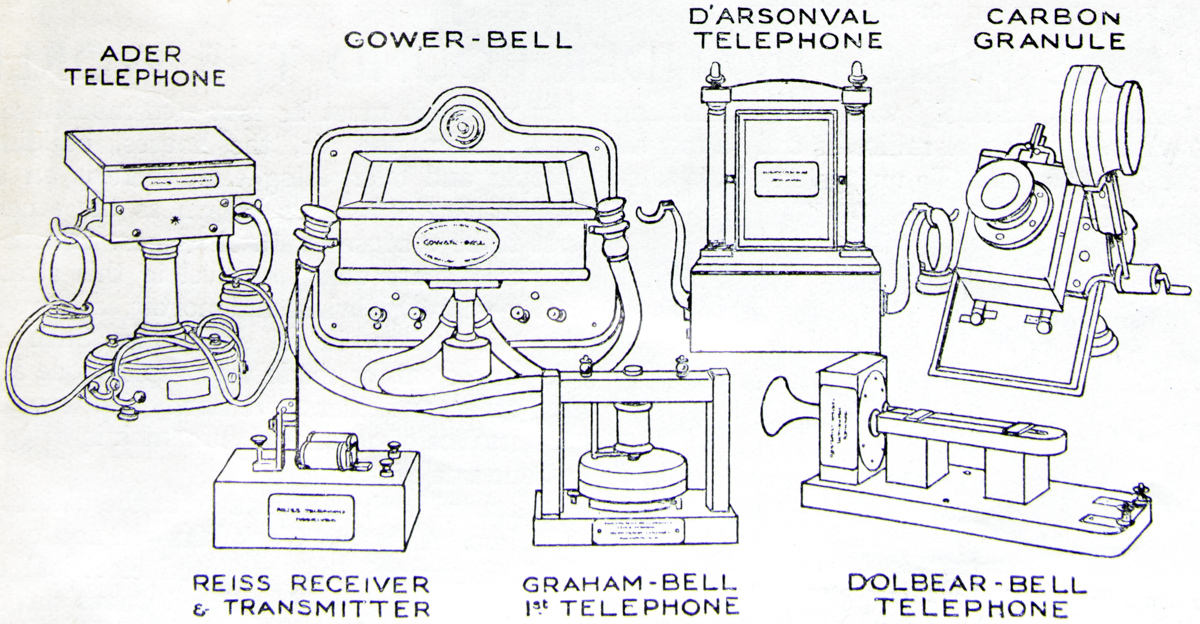
Another great step forward was made in 1876 when Graham Bell, a Scotsman, invented the telephone, but before going any further it will be advisable to get some idea of how electrical instruments work. The foundation of all electrical machinery, from powerhouses and locomotives to vacuum cleaners and electric bells, is the electro-magnet, invented by Sturgeon in 1825. He found that if a coil of insulated wire is wound round a piece of iron and a current is passed through the wire the iron immediately becomes magnetised—a simple enough phenomenon, although why the iron should become magnetised is a mystery to this day. Conversely, a magnet plunged into a coil of wire produces a current in the wire. Now suppose another piece of metal on a weak spring is placed near the iron core of the electro-magnet, then if a current is passed through the wire the metal will be drawn against the iron, and as soon as the current is cut off it will spring away again. Here, then, is the basis of the telegraph. The piece of metal can easily be made to strike a bell or turn a needle every time a current is passed, and the circuit can be so arranged that it is broken except when a plunger is pressed, so that every time the plunger is pressed at one end of the circuit the bell rings or the needle moves at the other. There are, of course, numerous refinements in use to give various indications, but the cables by which a message can be sent to Australia, 12,000 miles away, depend primarily on this simple contrivance.
|
|
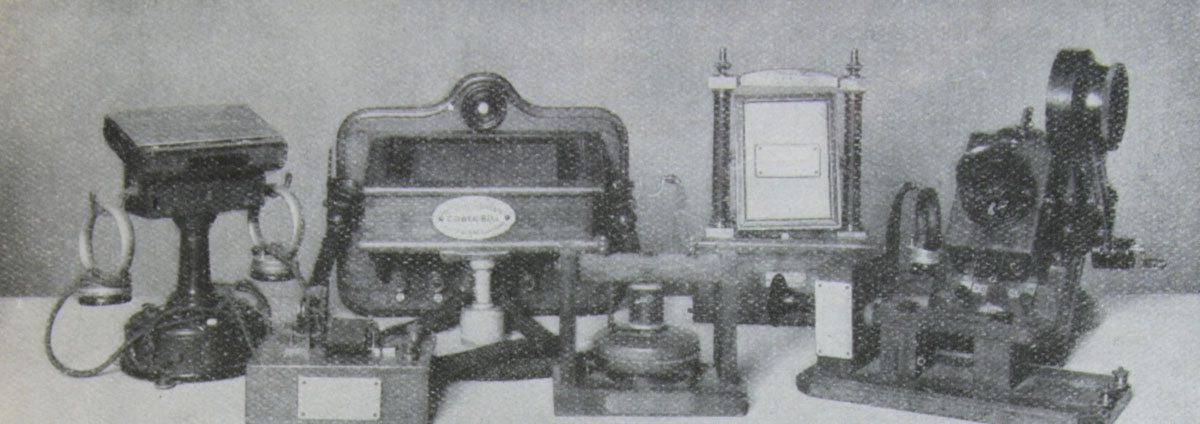
The telephone works upon practically the same principle, but introduces another ingenious idea. A piano wire vibrates when its particular key is struck; also the wire of a high note vibrates much more rapidly than the wire of a low note. If any thin board or similar article in a room where music is being played is touched lightly where conditions are suitable, it, too, vibrates. Now, it occurred to Graham Bell that if sound produces vibration, then, by reversing the process, vibration should produce sound, and it would be possible to turn the sound vibrations into electric current vibrations which could be transmitted along a wire, and this is the foundation of all the telephones and even wireless sets in use to-day.
Just inside the telephone mouthpiece there is a very thin metal plate with a magnet behind it and very nearly touching it. The speaker’s voice causes the plate to vibrate and move very rapidly alternately nearer and farther from the magnet, according to the particular tone and pitch of the voice, and this in turn causes bursts of electric current to pass through small coils which are connected with the magnet; this current is led through wires to the receiver’s telephone, where the process is reversed, i.e., instead of the vibrations of the plate causing spasmodic currents, the currents cause the plate to vibrate in precisely the same way as the original plate, and by listening to the ear-piece of the ’phone one hears the voice which is speaking into the transmitter.
As in the case of the telegraph, the telephone in practice is much more complicated than this, as the current has to be strengthened, and, of course, a house telephone can be connected not merely with one other instrument, but with millions of ’phones all over the world. There are about 800,000 telephones in London alone, and it is possible to speak to people in Manchester, Edinburgh, Paris, Berlin, New York, and, in fact, almost anywhere in the world, including far-distant Sydney and Melbourne, as clearly as if they were actually present. Electricity travels so fast that it would circle the world eight times in a second, so that even the most distant listener can hear as quickly as a person on the other side of a room.
|
All telephone lines in each district are connected with what is known as an exchange, and any local exchange can connect with any other exchange, if necessary, through several intermediate exchanges. Thus, if somebody in, say, village A near town B wished to speak to a friend in village C near town D, he would first be connected from A to B, then from B to D, and finally from D to C, although two or three other exchanges might intervene between B and D, but the speakers would not need to know anything of this, for the telephone operators would connect the lines as desired. At the present time telephone exchanges are being made automatic; instead of asking the telephone operator for the number wanted, callers may get it themselves by a most ingenious system of dialling. On each automatic telephone is a disc with numbers and letters printed on it, visible through holes in another disc which covers it ; by selecting the first three letters of the exchange name (e.g., CIT for City, CEN for Central) and the number of the person wanted, and turning the top disc accordingly, connections are made straight to the number desired without the attention of an operator at all. Moreover, if the line is engaged, a distinctive buzzing is heard, and if it is out of order a slightly different buzz. There are already 750 small exchanges in country districts which work without any attention apart from a fortnightly inspection by a telephone engineer.