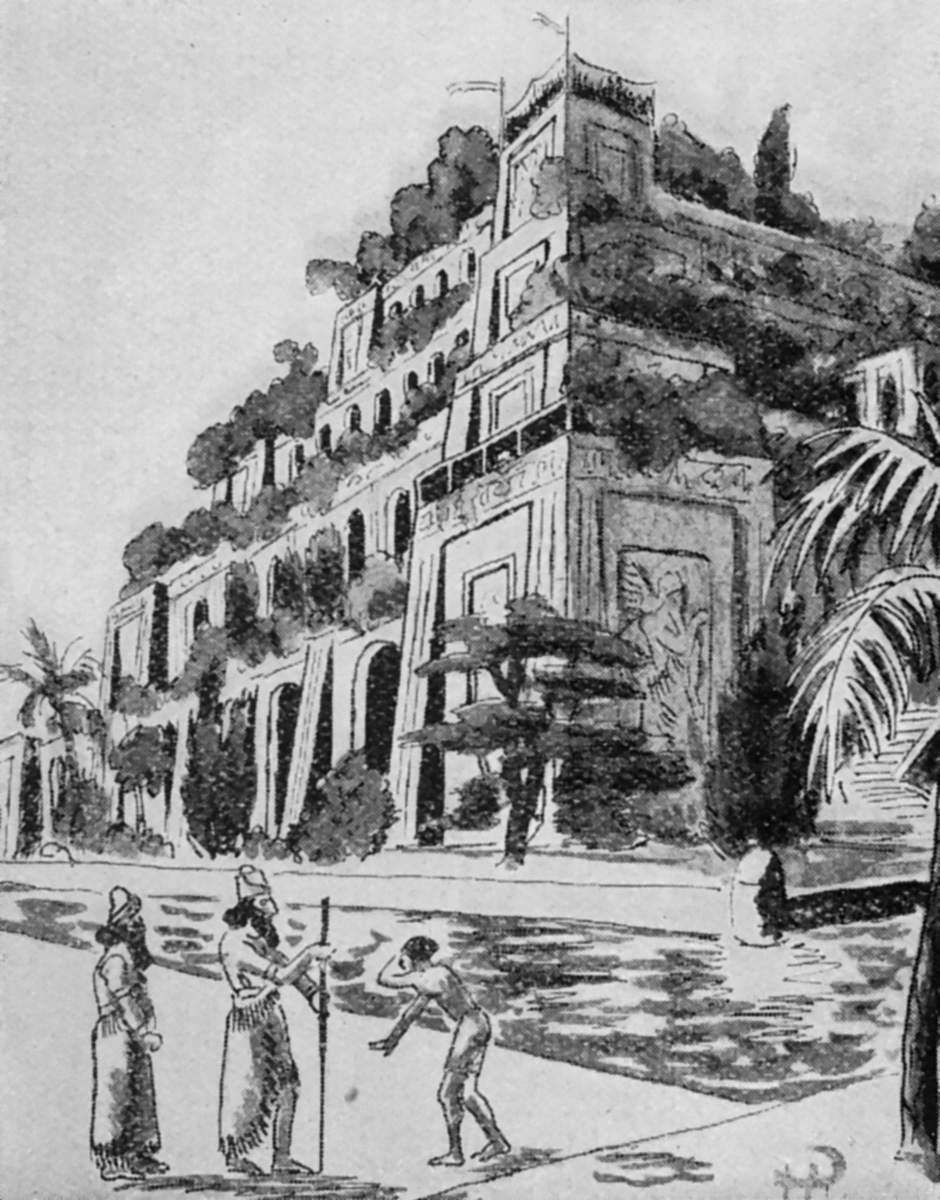
ABOUT fifty miles from Bagdad, on the bank of the river Euphrates, may be seen the ruins of a very, very old city which was once one of the great cities of the world and which attracted visitors from every country, for it was a city of wonders; its name, which means “Gate of God,” is Babylon. Nebuchadnezzar, of whom you will have heard in learning the Old Testament, was the king of Babylonia for forty-four years, from 604 to 561 B.C., and he it was who rebuilt the city of Babylon so that it became a kind of dream-city, too beautiful almost to be real. In it were numberless wonderful things, but the most marvellous of all were the Hanging Gardens of Babylon which held a place among the seven wonders of the world. Amytis, the Queen of Nebuchadnezzar, came from a mountainous country and she missed the hills and valleys of her own home, for the country of Babylonia is very flat; so the king, in order to make her happy and at home in her new surroundings, had these magnificent gardens constructed in his palace grounds. Diodorus, the Greek historian, and Strabo, the Greek writer on geography, have given descriptions of the gardens, which are unique in the history of the world.
|
|
These gardens appeared to be magically suspended in mid-air, for they were built one over the other and the lowest was placed high above the ordinary level of the ground, each one being supported on the very top of a series of arches, some of which were as high as seventy-five feet. The extent of the gardens was about four acres and in shape they were square. Deep plates of lead in the arches contained enough soil to grow huge forest trees and the flowers and plants were watered from a reservoir built at the top of the highest garden, the water for which was obtained by means of a screw from the Euphrates. One could look down from these heights on to the city of Babylon below, to the river Euphrates winding its course through the heart of the town, and on to the country all round.
In every garden were several terraces, marble and mosaic-worked banqueting rooms filled with palms, rhododendrons and sweetly-scented flowers, and round the walls hung paintings of mythological subjects, while special enclosures, wherein music and dancing could be performed daily, were not lacking. In the centre of large, velvety lawns were curiously shaped lakes, sometimes made so as to form the initial letter of the name of King, or Queen, or other important person, and swimming pools, in which the water was artificially coloured, red, gold, blue or any particular shade desired, to match the tiled paths inlaid with intricately patterned enamel work.
The gentle rhythm of falling water from cool fountains and the grander sound of foaming, rushing, water from artificially constructed waterfalls were provided in many parts of the grounds. Innumerable birds sang enchanting songs, and in glass-houses furnished with luxurious couches and rugs, one could feast one’s eyes on the gorgeous colouring of the humming bird, the paradise bird and the other lovely natives of tropical lands. Statues in marble and stone, expressing the religion of the country and recalling various historical episodes of great importance, were scattered throughout the grounds, usually in prominent positions.
Wide avenues of trees, lime-trees, ilexes and pines, and groves of palms, cedars, and cypresses, together with the large Cilician silver fir, afforded protection from the brilliant sunshine. At the sides, and sometimes in the middle, of the wide stretches of lawn were flower beds with gorgeously coloured orchids and fuchsias and other flowers, such as roses, chosen for their scent as well as for their perfection of form, so that the sight should be delighted with the beauty of colour and form and the sense of smell be satisfied with the odours carried by the breeze.
Along the walls trailed green vines with huge black grapes tempting the onlooker to pick them, while olives and melons grew in abundance. Clumps of date-trees were not scarce and raisins, even after the slaves and the birds had taken their share, still remained heavy on the boughs. Trees on which hung large, juicy lemons, to provide cooling drinks, had been planted at intervals all over tile gardens.
In this fairyland, the gracious gift of a king to his queen, Amytis spent her leisure hours of each day and here, when his state affairs for the day had been completed, did Nebuchadnezzar come to tell yet once again the tale of his love.